Microalgal products in health and personal care applications
GlycoMar has extensive expertise in the development of novel saccharide products from microalgae. Microalgae offer a unique opportunity for the bioeconomy because they represent enormous biochemical diversity, and can be grown both outside and in bioreactors, utilising light and CO2, resulting in a sustainable production system.
Microalgae
Microalgae are microscopic unicellular algae, typically found in freshwater and marine environments and existing individually, or in chains or groups. Microalgae are an extremely diverse group of organisms, which include both prokaryotes and eukaryotes and covers 14 phyla with examples described from almost every possible habitat. An estimate of 200,000 – 800,000 species of microalgae is widely quoted, of which only about 35,000 are described. Microalgal habitats include freshwater, seawater, soils, and extreme environments.
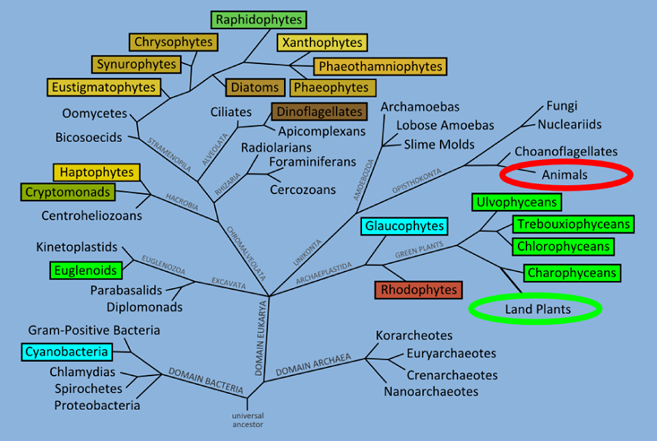
Phylogenetic tree highlighting the diversity and distribution of algae (boxed groups; colours indicate the diversity of pigmentation) across the domains of life (adapted from www.keweenawalgae.mtu.edu/). For comparison animals and land plants are encircled in red and green, respectively.
The use of microalgae dates back around 2000 years to the Chinese, who used Nostoc to survive during famine, and to the Aztecs who collected and cultivated Spirulina. Over the last 50 years microalgae biotechnology has developed for several commercial applications, including: use in aquaculture (feed), use in nutrition and as a source of nutritional supplements, use as a source of cosmetic ingredients, and use in biofuel production. These applications include cultivation for production of high value products such as fatty acids and carotenoids as nutritional supplements, and active cosmetic skincare ingredients. To our knowledge, the only microalgal products which have application as pharmaceuticals are high purity omega 3 fatty acids. GlycoMar has pioneered the development of glycomolecules from microalgae for the health and personal care markets, and has numerous contacts with chemical and cosmetic companies active in these sectors.
| Alga / classification | Annual production (t dry weight) |
Application / product | Production method |
|---|---|---|---|
| Arthropsira (Spirulina) Cyanobacteria |
3000 | Human & Animal nutrition, cosmetics, phycobiliproteins, phycocyanin | Open ponds, natural lakes |
| Chlorella Chlorophyta |
2000 | Human nutrition, aquaculture, cosmetics biofuels |
Open ponds, basins, glass-tube PBR |
| Dunaliella salina Chlorophyta |
1200 | Human nutrition, cosmetics, caroteneoids, b-carotene | Open ponds, lagoons |
| Aphanizomenon flos-aquae Cyanobacteria |
500 | Human Nutrition | Natural lakes |
| Haematococcus pluvialis Chlorophyta |
300 | Aquaculture, astaxanthin | Open ponds, PBR |
| Cryptothecodinium cohnii Schizochytrium Dinoflagellate |
240 t DHA oil | DHA oil | Fermentors (heterotrophic) |
| Chlamydomonas sp Chlorohyta |
NA | GMO protein expression | Glass Tube PBR, bag PBR |
| Tetraselmis sp. Nannochloropsis sp. Isochrysis sp. Nitzschi sp. |
NA | Aquaculture feed | |
| Porphyridium sp | NA | Polysaccharide cosmetic ingredient | Bag PBR |
PBR - photobioreactor
Recent microalgal R&D has been driven by the biofuel industry which has led to significant global investment in basic and applied research and development of large scale production facilities around the world.
Resources:
- AlgaeBase: online algal database:www.algaebase.org/about
- Algae Innovation Centre:www.cambplants.group.cam.ac.uk/cambridge-bioenergy-initiative/AIC
- OIlgae:www.oilgae.com
- Algal Biomass Association:www.eubia.org/cms/wiki-biomass/biomass-resources/algae/